The best bar stools hospitality operators choose do more than fill the counter line. They set the pace of service, influence how long guests stay, and carry a visible share of the interior concept. A stool that looks right in a showroom but feels unstable, sits at the wrong height, or wears poorly after a busy season becomes an expensive problem.
For restaurants, cafés, hotel bars, lounges, and high-traffic commercial spaces, selection should begin with use rather than appearance alone. The right model balances comfort, circulation, durability, cleaning requirements, and the visual character of the project. That balance changes from one venue to another, which is why commercial bar seating deserves a more precise specification process.
Best Bar Stools Hospitality Projects Can Depend On
A hospitality bar stool must perform under conditions that residential furniture rarely faces. It may be moved dozens of times a day, exposed to bags and shoes, cleaned repeatedly, and used by guests of different heights and body types. In busy venues, the stool also has to remain visually consistent across the room after months of service.
Start with the bar or counter height. For a standard 42-inch bar, a seat height around 30 inches is generally appropriate. For a 36-inch counter, a 24- to 26-inch seat height is usually the better fit. These dimensions should be confirmed against the finished countertop height, not early construction drawings. Stone thickness, wood cladding, floor finishes, and raised platforms can all change the final relationship.
Allow enough knee clearance below the counter and enough circulation behind each seat. A tightly packed bar may increase the seat count on paper, but it can make service slower and guests less comfortable. As a working reference, center-to-center spacing should account for the stool width, arm position if applicable, and the type of venue. A quick espresso bar can operate more tightly than a full-service restaurant where guests dine, socialize, and remain seated for longer periods.
Comfort Should Match Dwell Time
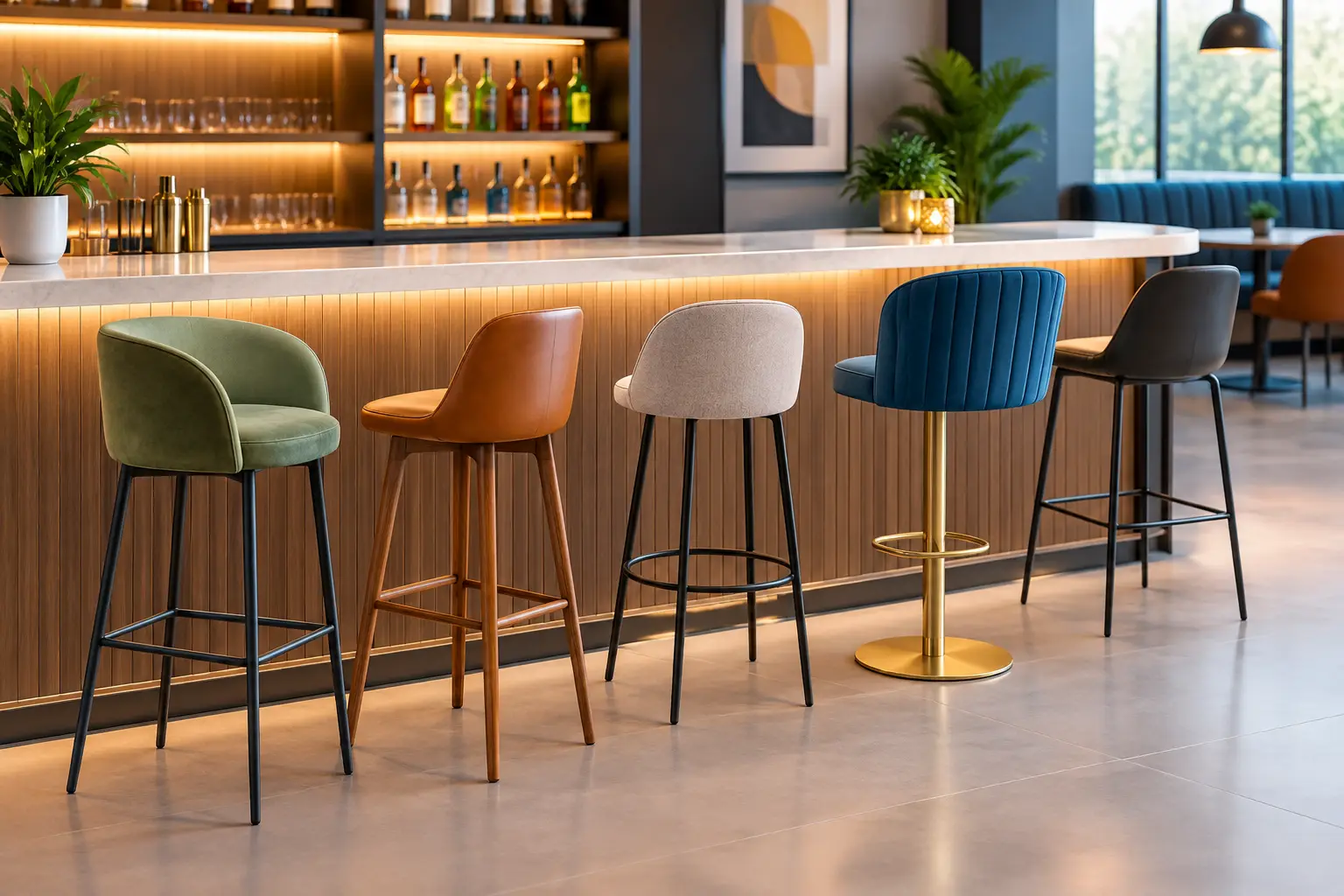
Not every bar stool needs the same level of support. A compact backless stool can suit a fast-moving café counter or an outdoor aperitif area. It keeps the visual line open and is easy to place under the counter. For a restaurant bar, hotel lobby, or cocktail venue, a low-back or full-back bar chair often provides a stronger guest experience.
Footrests are essential rather than optional. Guests need a stable place to rest their feet, particularly on taller seating. The footrest should be positioned naturally, integrated cleanly into the frame, and finished to withstand frequent contact. On metal stools, this area should receive particular attention because it is often the first surface to show scratches.
Upholstery adds comfort and elevates the perceived quality of the space, but it also creates a maintenance decision. High-performance commercial fabrics, vinyls, and contract-grade leathers can work well when selected for the venue’s cleaning routine. In a high-volume food and beverage environment, easy-clean performance may be more valuable than a delicate texture. For a quieter hotel bar or private-members space, a richer textile may justify the additional care.
Choose Materials for Real Commercial Use
Material selection should reflect location, traffic, and maintenance capacity. A beautiful finish is only a good choice when the operation can preserve it. This is especially relevant for bar stools because they are touched, pulled, rotated, and cleaned continuously.
Metal frames are a practical choice for many hospitality projects. They provide structural confidence, work across contemporary and industrial interiors, and can be finished in colors that support the wider palette. Powder-coated surfaces are often preferred for consistent coverage and everyday durability. For coastal properties, outdoor bars, or humid environments, the metal specification requires additional care to protect against corrosion.
Wood bar stools bring warmth and a more residential character to commercial interiors. They are particularly effective in cafés, bistros, boutique hotels, and restaurants that want a softer visual language. However, the timber species, stain, protective coating, and joinery must be selected for commercial use. A light natural finish can show marks more readily than a darker stain, while very dark finishes may reveal dust and scratches under direct lighting.
For outdoor hospitality areas, choose materials specifically built for exterior exposure. Indoor furniture moved outdoors for seasonal use rarely delivers the same service life. UV stability, drainage, moisture resistance, stackability where needed, and easy cleaning should guide the decision. Outdoor seating also benefits from a design that remains stable on imperfect paving and terrace surfaces.
Construction Details Buyers Should Inspect
Commercial buyers should look beyond the silhouette. The frame should feel solid without excessive weight, welds should be neat and consistent, and joints should be engineered for repeated lateral movement. A stool is rarely lifted perfectly straight. Guests drag it, lean against it, and shift their weight while entering or leaving the seat.
Check the connection between the seat and frame, the stability of the footrest, and the quality of floor glides. The right glide protects both the furniture and the finished floor while reducing noise in service. On upholstered pieces, ask how the upholstery is secured, whether the cushion can retain its form, and how replacement or repair can be handled if the project requires it later.
A sample review is valuable before full production. It allows the project team to test comfort, confirm dimensions, compare finishes under actual lighting, and evaluate the relationship between the stool and countertop. For multi-site rollouts or export projects, an approved sample also creates a clear benchmark for consistency across production.
Design the Stool Into the Full Interior
Bar stools should not be selected as isolated products. Their line, finish, and scale need to work with dining chairs, lounge seating, tables, lighting, wall materials, and the counter itself. A visual mismatch at the bar can make even a well-designed interior feel incomplete because the counter is often one of the first areas guests notice.
Consider whether the stool should blend into the architecture or act as a focal point. A restrained metal frame in a matte finish can support a minimal café interior without competing with the counter. A sculptural upholstered bar chair can create a more premium identity in a cocktail venue. Neither approach is automatically better. The right choice depends on the brand position, target guest, and how much visual activity already exists in the room.
Customization is particularly useful when a standard collection is close to the project brief but not fully aligned. Adjusting fabric, stain, metal color, seat height, piping, or frame detail can bring the furniture into line with the interior concept without developing an entirely new model. For larger hospitality projects, custom manufacturing can also help maintain design continuity between bar seating, dining seating, lounge pieces, and outdoor areas.
Plan Procurement Before the Interior Is Finished
A well-specified stool still needs a dependable delivery process. Buyers should establish quantities, final dimensions, finish approvals, packaging expectations, production timing, and delivery requirements early in the project. This protects the installation schedule and reduces last-minute substitutions that compromise the original concept.
For export orders, packing and logistics coordination matter as much as the furniture itself. Bar stools can require significant volume, particularly with fully assembled designs. Depending on the model and project needs, knock-down construction may improve container efficiency, while fully assembled pieces can reduce installation work on site. The decision should be made with the supplier based on product design, destination, handling capacity, and project schedule.
A productive manufacturer relationship also makes future requirements easier to manage. Hospitality spaces change. A new branch may open, a terrace may be added, or replacement units may be needed after heavy use. Working with a factory that understands the approved specification helps preserve consistency as the project grows.
Rezze Design supports this process through in-house manufacturing, tailored finishes, and project-focused production for commercial interiors. For architects, operators, wholesalers, and distributors, the advantage is practical: design decisions, production control, and commercial requirements can be addressed in one coordinated conversation.
The right bar stool should make guests feel naturally comfortable while allowing the operation to work efficiently every day. Specify it with the same care given to the bar counter, lighting, and service flow, and it will remain a productive part of the venue long after opening night.