A hospitality furniture packaging guide is not just a logistics document. For a restaurant opening, hotel renovation, or multi-location café rollout, packaging determines whether commercial furniture arrives clean, complete, and ready for installation. A well-made chair can still become a costly problem if its finish is rubbed in transit, its frame is bent by stacking pressure, or its hardware is separated from the shipment.
For buyers, architects, distributors, and project managers, packaging should be evaluated as part of the furniture specification. It affects freight efficiency, unloading time, damage rates, storage needs, and the final handover date. The right approach protects the product without creating unnecessary volume, labor, or waste.
What Hospitality Furniture Packaging Must Protect
Hospitality furniture faces a different journey than a residential retail order. Products may leave the factory in consolidated export shipments, move through ports and warehouses, and wait on a job site before installation. Each transfer point introduces risk.
The packaging plan should first protect the parts most likely to be damaged: exposed corners, powder-coated metal surfaces, upholstered panels, tabletops, feet, and joints. It should also prevent movement inside the carton or crate. A chair that shifts during handling can develop scratches or stressed connections even when the outer box looks intact.
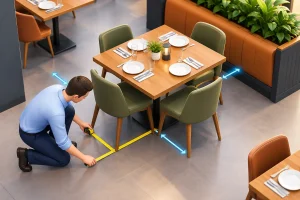
For commercial projects, protection also needs to account for how the furniture will be handled at destination. Hotel loading docks, city-center restaurant sites, and upper-floor installations often have limited access. Packaging that is secure but impossible to carry through a service entrance creates a new problem. The best solution balances product security with realistic site handling.
Match the Packaging to the Product
There is no single packaging method for every hospitality piece. Stackable metal chairs, upholstered armchairs, dining tables, bar stools, and outdoor furniture all require different protection levels.
Stackable chairs can often ship in nested units with separators between frames and contact points. This reduces cubic volume and can improve freight economics, but only if the separators prevent metal-on-metal abrasion and protect seat surfaces. For powder-coated finishes, wrapped contact areas and reinforced edge protection are particularly important.
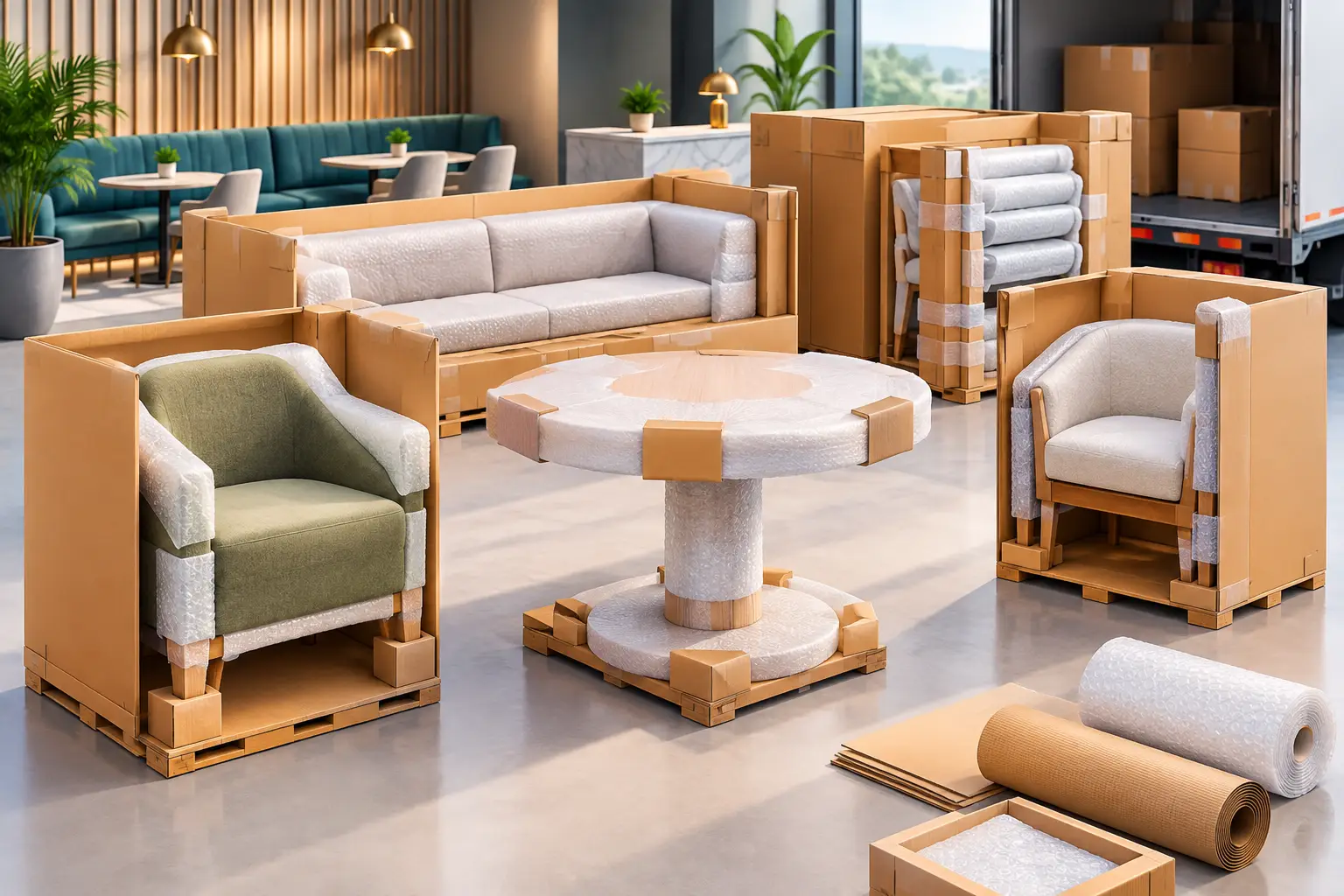
Upholstered chairs and sofas need breathable protective layers that shield fabric, leather, or vinyl from dust and friction without trapping moisture. Arms, legs, and decorative piping deserve additional attention. If legs are detachable, packing them separately can reduce damage risk and shipment volume, provided every carton is clearly labeled and the installation hardware is controlled.
Tables demand the most careful planning because their surfaces are highly visible and their dimensions can drive freight cost. Tabletops should be protected with face padding, corner guards, and rigid outer support. Bases and tops are generally safer when packed separately. This prevents the base from placing pressure on the finished top during movement and makes handling easier for the installation team.
Choosing Cartons, Pallets, and Crates
Packaging material should reflect the product value, order size, shipping route, and mode of transport. A local delivery may need less protection than a container shipment crossing multiple borders. At the same time, overpacking every item in heavy timber crates can increase freight charges and make disposal difficult at the project site.
Double-wall corrugated cartons are often suitable for chairs, stools, and smaller furniture components when internal protection is designed correctly. They are economical, easier to recycle, and practical for warehouse handling. Cartons should be sized to limit empty space. Void fill is helpful, but it should not be used to compensate for an oversized box or poor internal structure.
Palletizing is valuable for larger orders because it keeps cartons together, improves forklift handling, and reduces the chance of individual pieces being misplaced. Pallets must be stable, evenly loaded, and stretch-wrapped in a way that prevents shifting without crushing cartons. Corner boards and top caps add protection when loads will be stacked in transit.
Wooden crates are appropriate for delicate tabletops, high-value custom pieces, glass components, or shipments expected to face demanding handling conditions. They provide excellent structural protection, but they add weight, cost, and disposal considerations. For international shipments, wood packaging must meet applicable treatment and marking requirements. Buyers should confirm this before booking freight rather than discovering a compliance issue at the port.
Packaging Information That Keeps Projects Moving
Clear identification is as important as physical protection. A shipment may contain several chair models, multiple upholstery colors, table bases, tops, spare parts, and samples. If cartons are not labeled accurately, the receiving team can lose valuable installation time sorting through materials.
Each package should identify the project or purchase order, item code, product description, finish or upholstery reference, quantity, carton number, and gross weight. Where assembly is required, cartons should indicate whether they contain the main unit, legs, base, hardware, or tabletop. Simple handling marks for upright position, fragility, and moisture protection help carriers and site teams avoid preventable mistakes.
For larger projects, a packing list should make it easy to verify delivery against the order. This is especially useful when furniture arrives in phases or when the project has separate areas such as dining rooms, terraces, lounges, and guest rooms. Zone-based labeling can save time during installation because teams can move cartons directly to their intended location.
Hardware, Assembly, and Spare Parts
Missing hardware can delay an entire opening, even when every chair and table arrives on time. Bolts, glides, adjustment feet, brackets, and tools should be packed in sealed, labeled kits that are attached to or placed inside the relevant carton. Loose hardware should never be left to move freely against finished furniture.
For repeated models, it may be more efficient to supply organized hardware kits by room or furniture group. The right choice depends on the installation team’s workflow. Individual kits reduce confusion, while grouped kits can reduce packaging material and simplify large-scale assembly.
A modest supply of spare glides, fasteners, and touch-up materials can be valuable for commercial installations. These items are small, but they support a cleaner handover and make it easier to address minor site issues without waiting for a separate shipment.
Freight Efficiency Without Compromising Protection
Freight cost is shaped by weight, dimensions, stackability, and container utilization. This is why hospitality furniture packaging should be considered early, not after the furniture design has been finalized. A slightly revised table base, removable legs, or stackable chair frame can materially improve shipping efficiency.
Flat-pack or knock-down construction can reduce volume significantly, particularly for tables and selected seating. However, it is not always the right answer. Complex on-site assembly increases labor, creates opportunities for errors, and may be unsuitable where the installation team has limited time or technical experience. Fully assembled furniture can be the safer choice for intricate upholstered pieces or products where factory-controlled assembly is critical to long-term performance.
Container planning also matters. Mixing cartons of compatible sizes, using stackable product configurations, and avoiding unstable gaps can improve utilization while keeping loads secure. For export projects, an experienced manufacturer should be able to discuss carton dimensions, estimated shipment volume, pallet requirements, and loading strategy before production is complete.
Receiving and Inspecting Furniture at Destination
The delivery process should not end when the truck arrives. The receiving team should inspect visible packaging condition before signing freight paperwork, noting crushed corners, punctures, water exposure, or broken pallet wrap. Photographs taken at delivery can be important if a freight claim is needed later.
Cartons should be opened carefully, using tools that will not cut upholstery or scratch finished surfaces. It is wise to inspect a representative sample immediately, then continue with a full count and condition check as the installation progresses. Any concern should be documented with photos, carton labels, and item details while the information is easy to verify.
Keep original packaging until the inspection is complete. It may be needed for claim documentation, returns, or temporary protection while other trades are still working on site. In hospitality projects, furniture should be installed as late as practical, after dusty or high-risk construction work has finished.
Build Packaging Into the Supplier Conversation
The strongest furniture partnerships treat packaging as part of product quality, not as an afterthought. Ask suppliers how each item is protected, whether pieces ship assembled or knocked down, how cartons are labeled, and what documentation accompanies export orders. Share the delivery conditions early, including site access, floor level, installation timing, and any storage limitations.
At Rezze Design, factory production and project-focused planning make it possible to align furniture, finishes, packaging, and shipment preparation around the needs of the order. That coordination matters most when a project includes custom dimensions, mixed materials, or multiple product categories.
A package should do more than get furniture from one address to another. It should preserve the design intent, protect the investment, and help the installation team place every finished piece with confidence.