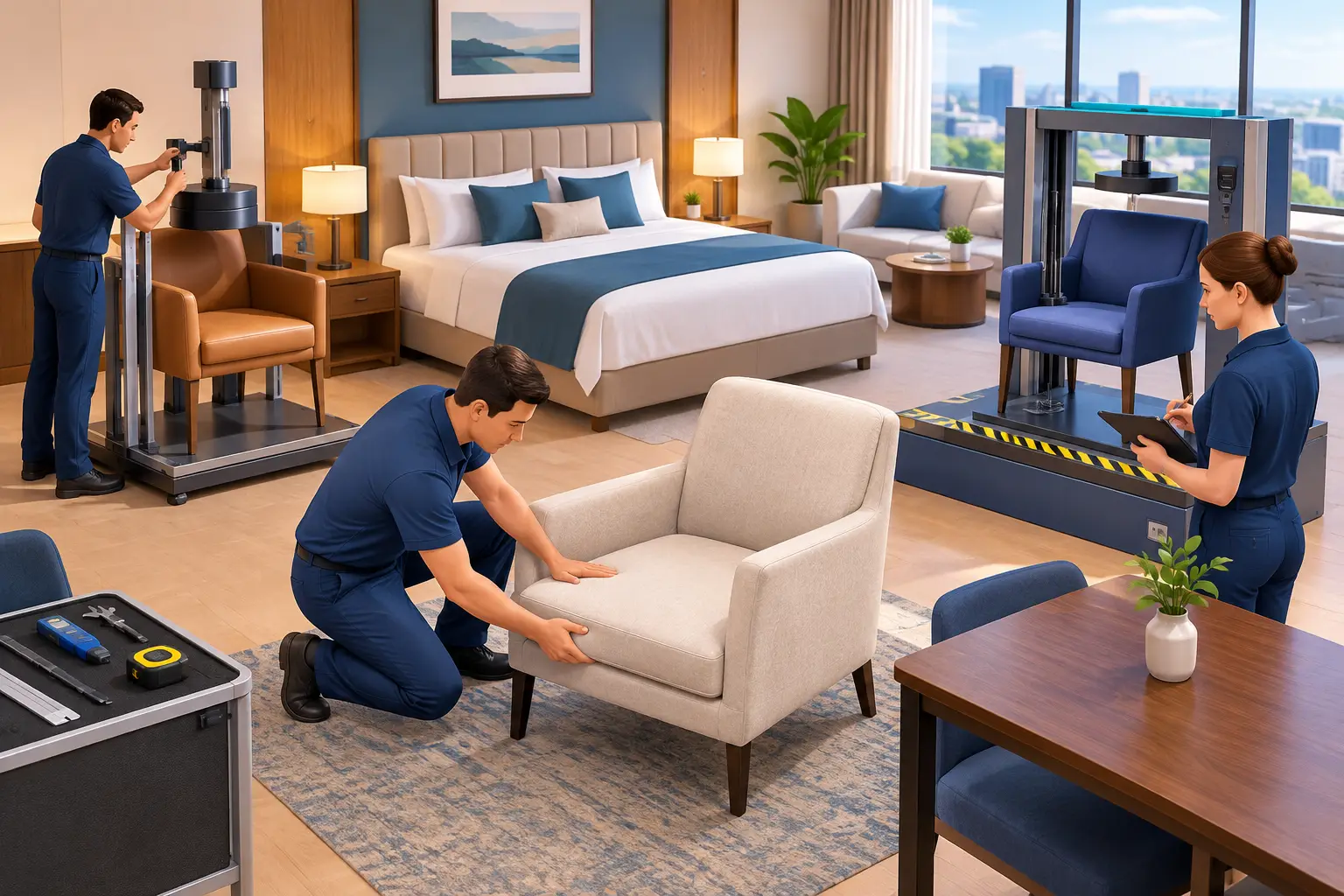
A restaurant chair may look perfect on opening day, then reveal its real quality six months later: a loosened joint, a scratched frame, worn upholstery, or a seat that no longer feels comfortable during a full service. Commercial furniture testing is the process that helps prevent those failures before furniture reaches the floor.
For hospitality operators, architects, distributors, and project buyers, testing is not paperwork added at the end of production. It is part of specifying furniture that can meet daily use, retain its visual standard, and support a reliable guest experience. A chair in a busy café is pulled, shifted, stacked, cleaned, and loaded far more often than a chair in a private home. The same principle applies to bar stools, lounge seating, tables, and outdoor collections.
What Commercial Furniture Testing Actually Measures
Commercial testing evaluates how furniture performs under defined use conditions. The exact test program depends on the product category, intended environment, applicable market requirements, and project specification. It may assess strength, durability, stability, surface resistance, material behavior, and safety-related details.
For seating, common concerns include whether the frame withstands repeated loading, whether the backrest and arms remain secure, and whether the chair stays stable when a guest leans, shifts, or rises from the seat. For tables, buyers need confidence in top strength, leg attachment, racking resistance, and stability on the installed floor surface. Outdoor products add weather exposure, corrosion resistance, UV performance, drainage, and material movement to the equation.
A test report alone does not make a product right for every project. A lightweight café chair and a fully upholstered restaurant armchair face different operating conditions. The useful question is not simply, “Has this been tested?” It is, “Has it been evaluated against the demands this project will place on it?”
Why Hospitality Furniture Needs a Higher Standard
Hospitality spaces create concentrated wear. A commercial dining chair can be used by hundreds of guests in a week. Staff may move it repeatedly between tables, cleaners may use it daily, and guests may place bags or coats on the back. In a bar, stools experience side loading and frequent turning. In hotel lobbies, lounge seating is expected to remain inviting despite constant traffic.
Failure affects more than replacement cost. A wobbling table interrupts service. Torn upholstery changes the perceived standard of the venue. A damaged chair can become a safety issue, while inconsistent furniture quality weakens a carefully planned interior concept.
This is why a commercial specification should connect design decisions to operating reality. A slim metal frame may support a contemporary look, but its tube thickness, welding quality, finish process, and connection details determine how it performs. A soft upholstered seat may create the desired comfort, but foam density, webbing, stitching, fabric selection, and cleaning requirements influence its useful life.
At Rezze Design, this connection between appearance and production detail is central to project work. Hospitality furniture needs to look considered from the first rendering through years of active service.
The Main Areas to Review Before Production
Testing should begin with the furniture design and material selection, not with a finished shipment. Reviewing several areas early helps buyers avoid expensive changes later.
Structural strength and durability
Structural tests apply repeated or controlled forces to simulate real use. They can expose weak welds, insufficient fastening, poor joint construction, unsupported upholstery platforms, or frame flex that may not be obvious during a showroom inspection.
For wood seating, joinery, moisture control, and reinforcement deserve close attention. For metal chairs and stools, weld consistency, tube profiles, and stress points around the seat and footrest matter. For sofas and armchairs, the internal frame, suspension, foam support, and upholstery attachment work together. One strong component cannot compensate for weakness elsewhere.
Stability and safety
A stable product is fundamental in commercial environments. Seating should resist tipping in expected use positions, while tables should remain secure when guests rest weight on an edge or when uneven floor conditions are present.
Product dimensions matter here. Seat height, back angle, arm placement, leg spread, and table base geometry all influence comfort and stability. A compact footprint may improve layout capacity, but it should not reduce the confidence guests feel when sitting down or standing up.
Surface, finish, and upholstery performance
Hospitality furniture is judged closely because guests see and touch it. Finishes need to support the project’s visual direction while accounting for cleaning, abrasion, moisture, spills, and daily contact.
A powder-coated metal chair may be appropriate for active dining areas because it can offer a consistent, durable finish when properly prepared and applied. Wood finishes should be selected with the expected cleaning routine in mind. Upholstery requires an equally practical approach: color, texture, abrasion resistance, stain behavior, cleanability, and fire-related requirements can all affect the final specification.
There is always a trade-off. A delicate bouclé may suit a low-traffic lounge concept, while a hard-working breakfast area may require a more forgiving commercial textile or contract-grade leather alternative. The best choice supports the design without creating unrealistic maintenance demands.
Environmental suitability
Outdoor furniture should not be treated as indoor furniture placed on a terrace. Sun, rain, humidity, coastal air, temperature shifts, and drainage create different risks. Aluminum, stainless steel, treated wood, technical fabrics, and weather-resistant finishes each have advantages, but the right material depends on the location and maintenance plan.
A coastal project may require greater attention to corrosion resistance than a covered urban patio. Likewise, furniture used seasonally may have different priorities from furniture exposed year-round. Clear use information at the quotation and sampling stage leads to better material decisions.
Standards, Project Requirements, and Market Expectations
Commercial furniture testing is often connected to recognized standards, but requirements vary by product and destination. U.S. projects may reference standards associated with commercial seating and institutional use, while European or other export projects can require different test methods. Fire regulations for upholstered materials may also vary by state, jurisdiction, building type, and contract requirement.
Buyers should confirm requirements before placing an order, especially when a project has a brand standard, public-use classification, or tender documentation. A manufacturer needs the intended market, furniture application, required standard, and any testing documentation request early enough to incorporate them into the product and production plan.
It is also useful to distinguish between testing a design and certifying a specific configuration. Changing a frame dimension, material thickness, upholstery construction, foam package, or base can affect performance. When a project includes custom details, the test strategy should reflect the final approved version rather than an only loosely similar catalog item.
A Better Testing Process for Custom Projects
For bespoke hospitality furniture, an effective process is practical and sequential. It starts with a clear brief: product type, expected traffic, dimensions, finishes, indoor or outdoor use, target market, and relevant standards. From there, drawings and material specifications can be reviewed before sample production.
The sample stage is where comfort, proportions, finish quality, and construction details should be assessed together. A chair may meet a dimensional requirement yet still feel too upright for long dining. A bar stool may look balanced but need a more durable footrest detail. Testing and sample review work best when they inform each other.
Before full production, approved materials, joining methods, finishes, packaging, and quality checkpoints should be documented. Factory control matters because consistency across a 20-piece order and a 500-piece project is part of commercial performance. Packaging also deserves attention, particularly for export shipments where damage in transit can undermine an otherwise well-made product.
Questions Buyers Should Ask Their Furniture Partner
A productive supplier conversation goes beyond price and lead time. Ask how the frame is constructed, which materials are proposed, what use conditions the product is designed for, and whether a comparable configuration has been tested. For upholstered pieces, ask about foam, suspension, fabric options, and cleaning guidance. For outdoor products, ask how the materials and finish suit the installation environment.
Also ask what happens when the design is customized. A capable manufacturer should explain how changes to dimensions, upholstery, bases, or finishes may affect performance, cost, production timing, and testing needs. That transparency helps architects and operators make informed decisions before commitments are difficult to change.
The strongest commercial interiors are not built by choosing between design and durability. They are built by specifying both from the beginning, then working with a manufacturing partner that can translate the concept into furniture made for real hospitality use.