

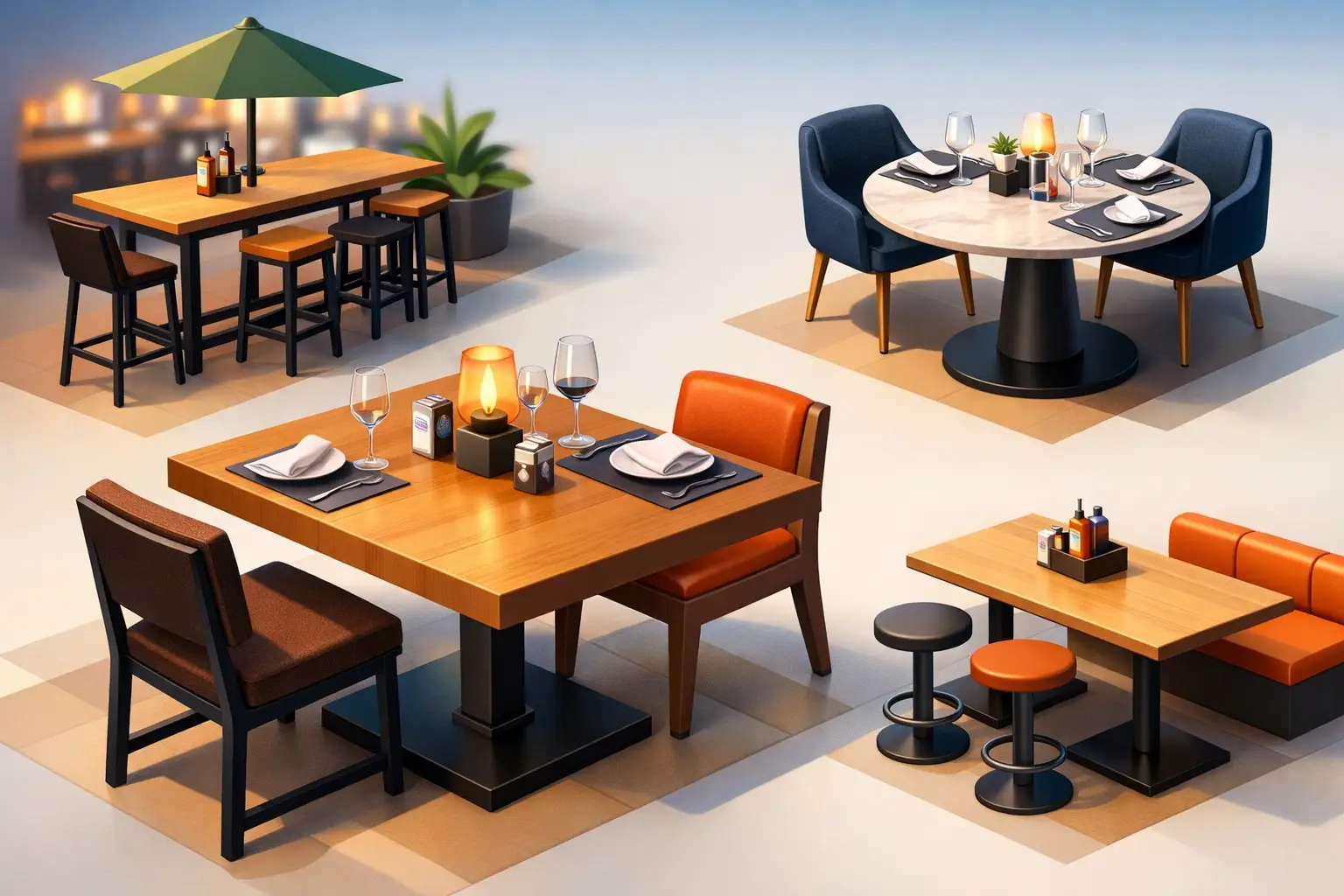
A restaurant table is never just a surface. It determines how many guests can be seated, how easily staff can move through the room, whether plates fit comfortably, and how the interior holds up after thousands of services. The best tables for restaurants bring visual character and commercial performance together, without forcing operators to compromise on layout, comfort, or maintenance.
For architects, restaurant operators, and hospitality buyers, the right choice begins with the concept but ends with the operating reality. A dramatic dining room loses value if tables wobble, tops stain easily, or the base prevents guests from sitting comfortably. Good table specification considers the full project: guest experience, traffic flow, cleaning routines, expected turnover, and the ability to reorder matching pieces as the business grows.
What Defines the Best Tables for Restaurants?
There is no single table style that suits every restaurant. A compact urban bistro, a high-volume breakfast venue, a fine-dining room, and an outdoor coastal restaurant have different priorities. Still, the strongest commercial tables share a few essential qualities: stable construction, proportionate dimensions, durable finishes, easy maintenance, and a design language that supports the wider interior.
Commercial durability should be assessed beyond appearance. Residential-grade furniture may look suitable in a showroom, yet restaurant use introduces repeated impact, frequent cleaning, shifting chairs, food spills, and uneven flooring. Tables need reliable joints, well-engineered bases, quality edge finishing, and materials selected for the intended environment.
The visual decision matters just as much. Tables occupy a large part of the guest’s sightline, especially in a dining room with low lighting or open seating. A warm wood surface can make a contemporary room feel more inviting. Metal details can introduce structure to an industrial or modern concept. Stone-look and compact surfaces can give a more refined, architectural feel while supporting demanding service conditions.
Start With Layout, Not the Catalog
The first question should be how the floor plan needs to perform. A table that is beautiful on its own can create operational problems if its footprint limits aisle clearance or prevents flexible seating arrangements.
For two-person dining, square and small round tables are often the most efficient choices. They can sit independently for intimate seating, then combine for larger parties when needed. Square tops usually align neatly in linear layouts, while round tops soften circulation and can make tight spaces feel less rigid.
Four-person tables are a core format for most restaurants, but their dimensions require care. A top that is too small creates conflict between place settings, water service, shared plates, and menus. A top that is too large consumes seats without providing a better guest experience. In many full-service concepts, a 30- to 36-inch square or round table is a practical starting point, with final sizing adjusted for the menu format and chair width.
Rectangular tables work particularly well along banquettes, walls, and communal seating zones. They can create an organized rhythm in larger rooms and are highly effective where a restaurant wants to accommodate groups without relying entirely on oversized shared tables. The trade-off is that long rectangular formats can make small spaces feel crowded if aisle widths are not protected.
A practical layout should account for service routes, chair pull-out space, accessibility requirements, and the movement of trays or clearing carts. It also needs to anticipate the reality of guest behavior. Bags, coats, high chairs, and larger group settings all take more space than a drawing may suggest.
Choosing Tabletop Materials for Real Service
The tabletop is the most visible and most heavily used component. Material selection should reflect the restaurant’s style, service pace, indoor or outdoor location, and maintenance capacity.
Solid wood offers depth, warmth, and a premium tactile quality. It is well suited to restaurants that want natural character, particularly when paired with carefully selected stains and protective finishes. However, wood needs a finish designed for commercial cleaning and moisture exposure. It may also require periodic refinishing in high-use locations. This is not a weakness when planned correctly, but it should be part of the operating expectation.
Wood veneer can provide a refined, consistent appearance with better control over material use and color matching. For many indoor hospitality projects, a high-quality veneer top with a durable commercial finish offers a strong balance of design value and cost. Edge protection and substrate quality are critical, especially where chairs or service equipment are likely to strike the table.
Laminate and melamine surfaces are practical for high-volume casual dining, food courts, cafés, and projects where fast cleaning is a major priority. Contemporary options have improved significantly, offering wood, stone, and solid-color appearances that work well in modern interiors. Their limitation is often edge damage or lower perceived luxury if the specification is not carefully selected.
Compact laminate is an excellent option for outdoor use and demanding indoor environments. It performs well against moisture, heat, and frequent cleaning, while offering a clean, contemporary profile. It can feel less warm than wood, so it is often balanced with upholstered seating, textured finishes, or natural materials elsewhere in the project.
Stone, sintered stone, and ceramic tops create a high-end statement and offer strong resistance to heat and staining. They are particularly effective in premium dining settings, hotel restaurants, and concepts where the tabletop itself is intended to be a design feature. Their weight, cost, edge treatment, and base engineering need early consideration. A heavy top on an undersized base is not a durable solution.
The Table Base Is a Comfort Decision
Guests may not consciously inspect a table base, but they immediately feel its effect. A base that interferes with knees, feet, or chair placement creates an uncomfortable dining experience, even when the tabletop is attractive.
Central pedestal bases are one of the most versatile choices for restaurant tables. They allow chairs to move freely around the top and make it easier to combine tables for larger parties. A properly weighted pedestal can provide excellent stability, but the base plate and column must be matched to the tabletop size and material.
Four-leg tables offer a familiar, residential-inspired look and can work beautifully in design-led restaurants. They are often a good option for smaller square tables or spaces where a lighter visual profile is needed. The risk is leg interference at corners, particularly when the table is used by four adults or pushed together with adjacent units.
Trestle and dual-base systems are useful for larger rectangular tops, communal tables, and banquette layouts. They distribute weight effectively and can create a strong architectural presence. Their positioning must be coordinated with seating dimensions so guests are not forced to straddle a support structure.
For restaurants with uneven floors, adjustable glides are a small but essential specification. They prevent movement, reduce floor damage, and help maintain a professional guest experience. A table that rocks during service can undermine the quality of the entire room.
Matching Table Style to the Restaurant Concept
The best projects use tables as part of a coherent furniture system. Instead of selecting each piece independently, consider the relationship between the tabletop, chair frame, upholstery, lighting, flooring, and wall finishes.
A contemporary café may combine light oak or walnut-look tops with slim black metal bases and upholstered dining chairs. A more formal restaurant may use darker timber, stone-look surfaces, or richer metal details to create depth. For an outdoor venue, weather-resistant tops and powder-coated metal frames can maintain a polished appearance while handling sun, moisture, and regular cleaning.
Color consistency deserves attention. Natural timber should be sampled under the actual project lighting, not only under showroom lighting. Powder-coated metal colors can shift under warm or cool illumination. If a project uses multiple table sizes, tops and bases should be specified as a family so the room feels intentional rather than assembled over time.
Custom production becomes especially valuable when standard sizes do not fit the layout. A tailored tabletop dimension, a specific stain, a modified base height, or coordinated metal finish can solve a practical problem while preserving the concept. For project buyers, this flexibility can reduce the need to redesign a floor plan around generic furniture dimensions.
Specify for Procurement, Reorders, and Export
A table order should be documented as clearly as any other commercial finish package. Include top dimensions and thickness, material and finish code, edge profile, base model, metal color, height, glides, quantity by size, and packing requirements. For export projects, packaging is part of product protection, not an afterthought. Tables with removable bases or carefully designed knock-down construction can improve container efficiency while simplifying site assembly.
Sample approval is equally valuable. A physical sample lets the project team assess color, texture, sheen, edge quality, and cleaning performance before full production begins. This matters most for custom stains, veneer selections, stone-look surfaces, and powder-coated metal finishes.
For projects requiring a coordinated supply partner, Rezze Design combines in-house table production with chairs, seating, and tailored hospitality furniture support. That helps architects, operators, and distributors maintain greater control over finish matching, production communication, and project consistency.
A Better Way to Make the Final Selection
Before confirming a table model, place it into the actual seating plan and test it against the menu, chairs, service style, and expected turnover. Sit at it. Pull the chairs out. Consider where bags, shared plates, and tableware will go. Ask how the finish will look after a busy Saturday night, not only on opening day.
The right table should make the room easier to operate and more enjoyable to return to. When its scale, material, base, and finish are specified with care, it becomes a quiet but lasting part of the restaurant’s reputation.