
A stackable chair earns its place in a hospitality project when it does more than save storage space. For a restaurant terrace, café floor, banquet room, or multipurpose venue, it must support daily service, protect the visual concept, and withstand repeated handling by staff. Knowing how to choose stackable chairs means evaluating the chair as a working commercial asset, not simply as a convenient extra seat.
The strongest choice balances comfort, durability, stackability, and a design language that belongs in the space. A chair that looks refined but stacks poorly can slow down operations. One that stores efficiently but feels unstable or uncomfortable can undermine the guest experience. The right specification considers both sides from the start.
Start With the Operating Environment
Before comparing silhouettes, materials, or finishes, define where and how the chairs will be used. A compact indoor café has different priorities from an all-day restaurant, hotel breakfast area, conference venue, or outdoor dining concept.
For indoor spaces, floor protection, acoustic comfort, upholstery options, and the relationship between the chair and interior lighting may be central concerns. For outdoor areas, weather resistance, drainage, UV stability, corrosion protection, and ease of cleaning become more relevant. In a venue that resets tables every day, staff handling and storage speed can matter as much as appearance.
Also consider frequency of movement. Chairs used only for occasional private events may tolerate a more delicate finish or a lower stack count. Chairs moved between indoor and outdoor zones several times a day need a more forgiving construction and finish. A project specification should reflect real operational habits, not ideal conditions.
How to Choose Stackable Chairs That Stay Comfortable
Stackability should never require guests to compromise on comfort. Hospitality guests may sit for a quick coffee, a long dinner, or several hours during an event. Seat width, back support, arm position, and edge detailing all influence how a chair feels over time.
A well-proportioned seat creates comfort without making the chair overly large or difficult to place around tables. The backrest should offer support in a natural sitting position, particularly for dining concepts where guests remain seated through multiple courses. If the project uses armchairs, check that arm height works with the intended table height. An attractive armchair that cannot slide close enough to the table creates an immediate usability problem.
Materials affect comfort as well. Upholstered seats can bring warmth and a more premium feel, but the fabric or leather specification must suit the volume of use and cleaning routine. Polypropylene, molded shells, wood, and metal can be highly effective in commercial settings when their contours are thoughtfully designed. For longer dwell times, seat pads or upholstered panels may be worth the additional investment.
Requesting a sample is the most reliable way to assess comfort. Have multiple people sit in it, move it, lift it, and position it at the actual table model. A chair can look correct in a catalog and still feel too narrow, too upright, or too low once it enters the project.
Evaluate the Stack, Not Just the Individual Chair
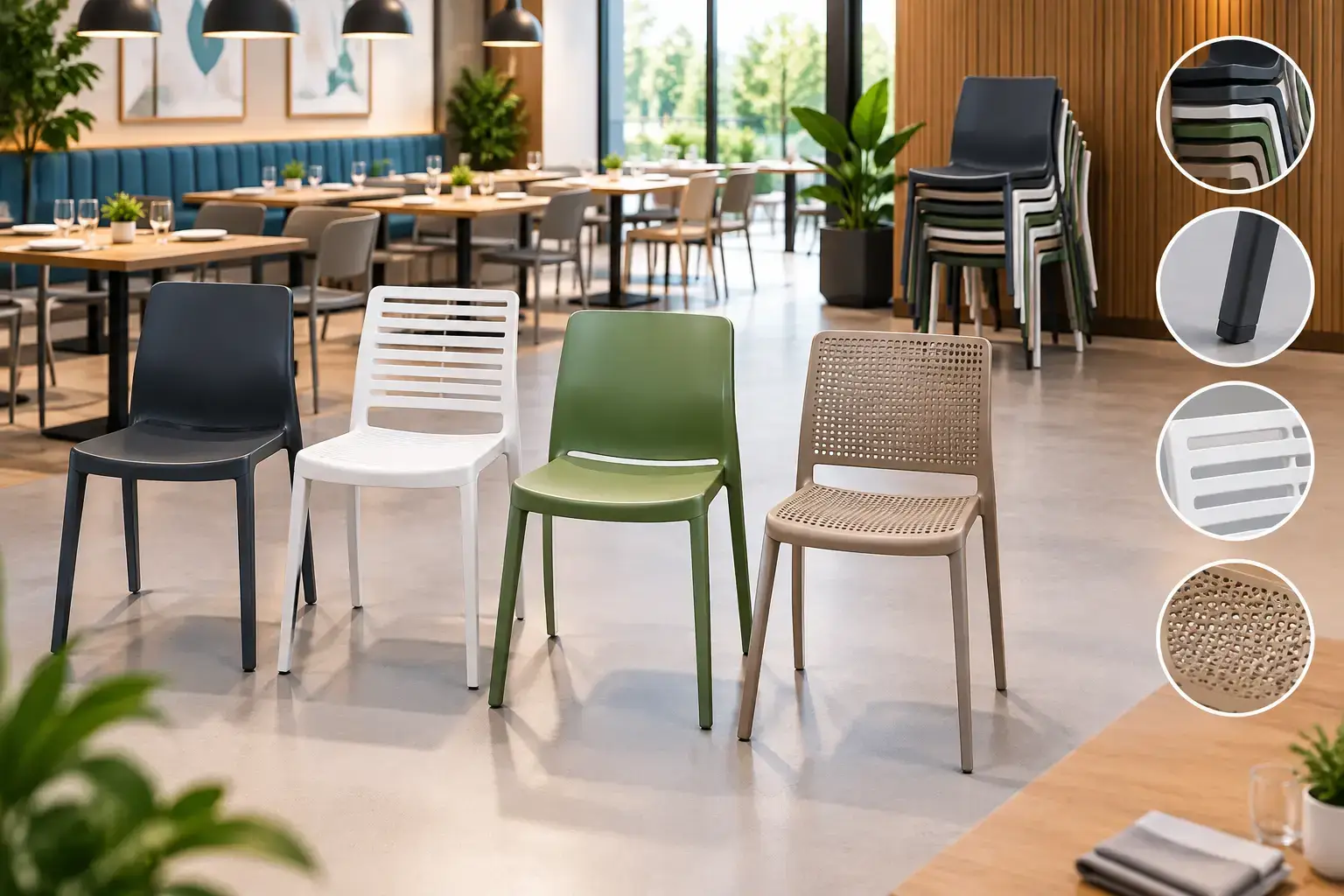
Every stackable chair should be assessed in its stacked condition. Ask how many chairs can be safely stacked, how much floor area that stack requires, and whether one person can move it without difficulty. These details affect labor, back-of-house planning, and the condition of the furniture over time.
Look closely at the contact points between chairs. Protective glides, stack bumpers, and carefully engineered frame geometry help prevent scratches, dents, and friction marks during stacking. This is especially important for painted metal finishes, wood elements, and upholstered surfaces.
The stack height must also match the storage room and the staff workflow. A high stack may save floor space but be impractical in a low-ceiling storage area or difficult for shorter staff members to manage safely. If the venue regularly stores large quantities, a compatible trolley can make transport faster and reduce unnecessary wear.
There is a trade-off here. The most compact stacking chair is not always the most comfortable or visually substantial option. For front-of-house seating, it is often better to select a chair with a moderate stack count and stronger guest appeal than one designed purely for maximum storage density.
Select Materials for Commercial Durability
The material should respond to the setting, the desired aesthetic, and the maintenance capacity of the operator. There is no single best option for every hospitality project.
Metal stackable chairs offer strength, clean contemporary lines, and a broad range of powder-coated finishes. They are well suited to high-traffic interiors and many outdoor applications when the coating system and corrosion protection are specified appropriately. Check weld quality, frame thickness, and the consistency of the finish, particularly at joints and edges where damage is more likely to appear.
Wood chairs create warmth and visual character, making them particularly effective in restaurants, boutique hotels, and design-led cafés. However, wood requires thoughtful finish selection and should be protected from repeated impacts during stacking. If chairs will move frequently, confirm that the stacking system prevents wood-on-wood contact.
Polypropylene and other technical polymers can be lightweight, easy to clean, and efficient for large-scale use. They are a practical choice for casual dining, outdoor areas, and flexible event spaces. Their quality varies significantly, so examine the molding, structural reinforcement, color consistency, and UV performance rather than choosing on price alone.
For outdoor projects, verify that every element is suitable for exterior exposure. A weather-resistant seat paired with unprotected metal hardware can still become a maintenance issue. Commercial outdoor furniture should be specified as a complete system.
Match the Chair to the Design Concept
Stackable does not have to mean temporary or generic. In contemporary hospitality interiors, flexible seating can still carry a clear design point of view. The chair should work with the project’s table bases, lighting, flooring, materials, and brand identity.
Consider scale first. A visually heavy chair can crowd a small café, while a very light chair may disappear in a large restaurant with dramatic finishes. Open-back designs can keep compact rooms feeling more spacious. Upholstered or fuller-profile chairs can give larger dining rooms a more settled, premium atmosphere.
Color and finish deserve the same attention. Neutral tones may support long-term flexibility, while a custom color can create a recognizable project signature. For multi-location concepts, a consistent chair specification can reinforce brand recognition while allowing fabric, finish, or frame color to adapt to each site.
Custom manufacturing is particularly valuable when standard dimensions or finishes do not fully answer the brief. A tailored upholstery selection, metal color, wood stain, or detail can help a project achieve a more individual result without losing the operational advantages of a proven stackable structure.
Check Stability, Safety, and Serviceability
A commercial chair must feel stable on the floor and remain stable as it ages. Test it on the actual flooring type whenever possible. Uneven tile, textured outdoor surfaces, and wood flooring can reveal issues that a showroom floor does not.
Inspect the connection between the frame and the seat or shell. Look for quality welding, secure fastenings, clean finishing, and glides that can be replaced when worn. Replaceable parts can extend the working life of the chair and help operators maintain a consistent appearance across the venue.
Weight is another practical consideration. Lightweight chairs are easier for staff to rearrange, but extremely light construction can sometimes feel less substantial to guests or perform poorly under intensive use. The goal is controlled weight: manageable for daily operations, yet solid enough for a commercial environment.
For U.S. projects, buyers should also confirm that the chair specification supports applicable commercial requirements, project standards, and local code considerations. A manufacturer should be prepared to provide clear product details, finish samples, packing information, and production guidance before an order is confirmed.
Plan Procurement Around the Full Project
The purchase price is only one part of the decision. Consider expected lifespan, replacement needs, storage equipment, lead time, packaging, and freight planning. A chair that requires frequent replacement or arrives with inconsistent finishes can become more expensive than a higher-quality alternative.
For larger projects, consistency across production batches matters. Ask how color, upholstery, frame finish, and dimensions are controlled. This is especially relevant for phased openings, multi-site rollouts, and distributor programs where future orders need to match previous deliveries.
Rezze Design supports hospitality projects with in-house manufacturing and tailored production options, helping architects, operators, and commercial buyers align chair specifications with the wider interior scheme. Early coordination makes it easier to confirm materials, stackability, packaging, and production timing before the project reaches a critical stage.
The best stackable chair is the one your team can store efficiently, your guests can sit in comfortably, and your design concept can stand behind for years. Start with a real floor plan and real service conditions, then choose a supplier prepared to treat those details as part of the product.