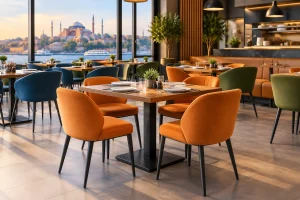


A wood restaurant table supplier is not simply a source for tabletops and bases. For a restaurant, café, hotel, or multi-location rollout, the supplier becomes part of the project team responsible for how the space looks, performs, and holds up after opening day. The right partner helps translate an interior concept into tables that fit the floor plan, withstand daily service, and arrive with the consistency a commercial project requires.
Wood tables remain a strong choice for hospitality interiors because they bring warmth, texture, and visual depth to a room. But not every wood table is built for commercial use. The difference is found in material selection, construction, finishing, production control, and the supplier’s ability to support the project from sampling through delivery.
What to Expect From a Wood Restaurant Table Supplier
Commercial table buying starts with performance, not just appearance. A dining table may look refined in a showroom but fail quickly when exposed to repeated cleaning, sliding tableware, temperature changes, spills, and constant guest turnover. A capable supplier understands those conditions and designs accordingly.
For restaurant projects, ask how the tabletop is constructed, what finish is used, how the edges are protected, and which base options are compatible with each size. These details affect stability, maintenance, and the number of covers that can be comfortably placed at each table. They also affect the service team. A base that interferes with chairs or leaves inadequate legroom can create a daily operating problem, even if it looked right in a rendering.
The best suppliers balance design intent with practical hospitality requirements. They should be able to discuss wood species, veneer versus solid wood, tabletop thickness, edge profiles, stain color, base materials, and packing methods in clear commercial terms.
Start With the Restaurant’s Operating Conditions
A wood table for an all-day urban café faces different pressure than one in a fine-dining restaurant with tablecloth service. Before selecting a collection or developing a custom piece, define how the tables will actually be used.
High-turnover venues generally need finishes that tolerate frequent wiping and minor impact. Outdoor-adjacent areas may require greater resistance to humidity and sunlight, while restaurants with heavy table movement need bases designed for repeated repositioning. A large communal table needs internal support and a base configuration that prevents sagging or instability across its length.
Also consider the kitchen and front-of-house routine. If tables are stacked, joined for events, or moved nightly for cleaning, weight matters. A thick solid-wood top can make a strong visual statement, but it may be less practical than a high-quality veneered construction for some layouts. Veneer is not automatically a compromise. When properly specified and finished, it can provide a consistent, premium surface while improving dimensional stability and controlling weight.
This is where a supplier should offer judgment rather than simply approve every request. A successful project is built around the right solution for the room, not the most expensive material in every application.
Material and Finish Decisions That Affect Longevity
Wood tables succeed when the construction and finish suit the environment. Solid wood offers natural character, including grain variation and tonal movement, which can strengthen a concept built around authentic materials. It also requires realistic expectations. Natural timber responds to its environment, and a commercial finish should help protect the surface without hiding the material’s character.
Engineered wood and veneered tabletops can be particularly effective for larger-format restaurant tables. They offer reliable flatness, controlled grain matching, and efficient production for projects requiring many units. The key is quality: substrate selection, veneer thickness, edge treatment, and finishing standards all influence the final result.
Finish samples should be reviewed under the project’s actual lighting whenever possible. Warm lighting can deepen a walnut stain, while bright daylight may reveal undertones that were not obvious in a showroom. Request samples that show the proposed stain, sheen level, and wood grain. A low-sheen surface often feels contemporary and hides minor marks better than a highly glossy finish, though the right choice still depends on the brand concept and cleaning routine.
Choose Dimensions Around Covers, Not Empty Space
Restaurant layouts can make a table look generously sized on paper while leaving too little room for guests, chairs, or service circulation. Table dimensions should be planned around the intended number of covers, plate presentation, and chair footprint.
A compact two-top may work well for coffee service and light meals, but it can feel crowded for full dining with shared plates. Larger rectangular tables can increase seating flexibility, while round tables support conversation and soften a room with many straight lines. Yet round tops require careful base selection to prevent wobble and preserve legroom.
Custom sizing is valuable when a standard collection does not fit the layout. It can help align tables with banquettes, columns, window bays, and circulation paths. However, custom production should be managed with discipline. Confirm the final dimensions, edge profile, finish code, base model, and quantity before production begins. Small changes made late in the process can affect drawings, material planning, and lead times.
Base Design Is Part of Table Performance
The base is often treated as a separate purchase, but it should be evaluated with the top. A metal pedestal base can give a wood tabletop a clean contemporary profile and improve seating flexibility. Four-leg bases may suit certain designs, though their leg placement must be checked against chairs and table corners.
For hospitality use, base weight, weld quality, leveling glides, and finish durability deserve attention. Floor conditions are rarely perfect. Adjustable glides help stabilize tables on uneven surfaces and reduce the familiar problem of a table that rocks during service. The supplier should specify the correct base size and weight for the tabletop dimensions rather than applying one base across every format.
Why Factory Control Changes the Buying Process
Working directly with a manufacturer gives project buyers more control over specifications and communication. Instead of sourcing a tabletop from one company, a base from another, and custom finishes from a third, a factory-led supplier can coordinate the components as one product.
That matters when projects require matched finishes across dining tables, bar tables, communal tables, and complementary seating. It also improves accountability. The same team can review the approved sample, manage production details, inspect finished pieces, and prepare export packing.
For architects, designers, distributors, and operators, factory capability also makes customization more practical. A project may need a specific diameter, a softened corner radius, a new stain color, or a base adapted to local venue conditions. These requests are easier to evaluate when the supplier controls production rather than acting only as a reseller.
Rezze Design supports hospitality projects through in-house manufacturing, combining contemporary table design with custom dimensions, finishes, and coordinated seating solutions. This approach is particularly useful when the goal is a coherent commercial interior rather than a collection of unrelated furniture purchases.
Questions to Ask Before You Place an Order
A supplier should be ready to answer detailed questions before an order is confirmed. Ask for the technical specifications of the top and base, including dimensions, materials, finish type, and recommended use. Clarify whether the supplied sample represents the final production standard, especially where natural wood variation is expected.
Lead time should be discussed alongside production capacity, not as a vague estimate. For export orders, confirm how tables are packed, whether tops and bases ship assembled or separately, and how the supplier supports documentation and logistics coordination. Flat-packed components can reduce shipping volume, but they must be designed for straightforward assembly on site.
It is also sensible to discuss replacement planning. In high-volume projects, keeping a clear specification record makes it easier to reorder matching tables later. This is especially important for restaurant groups and distributors that may expand to new locations after the first project is complete.
Evaluate Price as a Total Project Cost
The lowest unit price can become expensive if the tables require early refinishing, arrive with inconsistent finishes, or create delays during installation. A meaningful comparison includes material quality, customization, production reliability, packaging, and expected service life.
There are situations where a standard table is the best commercial choice. If the project has a tight opening date and a proven collection fits the concept, selecting an established model can reduce risk. Custom tables make more sense when the brand identity, layout, or operating needs demand a precise solution. A knowledgeable supplier should help distinguish between those two cases.
A wood restaurant table should earn its place through more than visual appeal. When the material, dimensions, base, finish, and production process are aligned, it supports the guest experience and the business behind it. Choose a supplier that can speak confidently about every one of those decisions, then build the project around furniture designed to perform long after the opening photos are taken.