
A restaurant chair can look exceptional on opening day and still become a costly specification mistake if its upholstery does not meet the project’s fire requirements. Knowing how to choose fireproof upholstery means looking beyond fabric color, texture, and price. For hospitality seating, the real decision involves the complete upholstered assembly, the applicable code, daily maintenance demands, and the documentation needed before delivery.
For cafés, restaurants, hotels, lounges, and public-facing commercial spaces, upholstery must support the interior concept while standing up to intensive use. A well-specified material protects the project schedule, supports approval with the client or authority having jurisdiction, and helps preserve the appearance of chairs, bar stools, sofas, and banquette seating over time.
Start With the Required Fire Standard
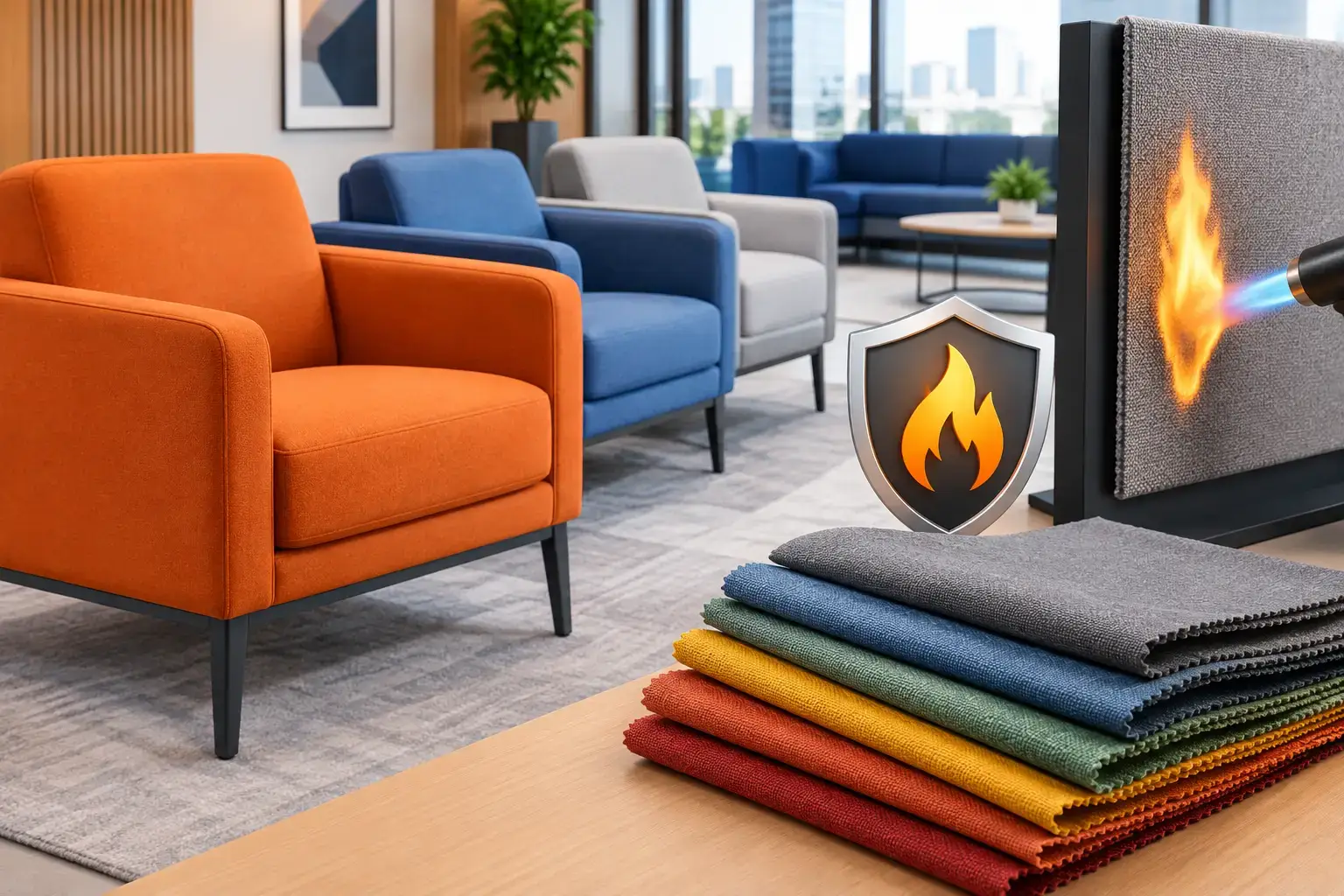
“Fireproof” is widely used in project discussions, but it can be misleading. Most upholstery is not completely immune to fire. The more accurate terms are flame resistant, fire retardant, or compliant with a stated ignition-resistance standard. The required performance level depends on the building type, occupancy, jurisdiction, and the client’s specification.
For US commercial projects, buyers may encounter standards such as NFPA 260 for cigarette ignition resistance, NFPA 261 for upholstered furniture mock-up testing, ASTM E1537 for resistance to ignition by a flaming source, and California TB 133 for certain institutional or public-assembly applications. California TB 117-2013 is also commonly referenced, but it is not a universal substitute for a commercial furniture requirement. It is essential to confirm what applies to the actual project rather than specifying a familiar test name by default.
The first practical step is to request the fire schedule from the architect, designer, operator, or code consultant. Ask whether the requirement applies to the cover fabric only or to the finished furniture item. If it applies to the full assembly, the fabric certificate alone is not enough. The specified foam, interliner, barrier, filling, frame construction, and upholstery method can all affect the result.
Build the specification around the finished seat
A fabric that performs well in a laboratory test may not deliver the same result once it is combined with a particular foam and construction method. This matters especially for custom hospitality furniture, where seat depth, cushion configuration, stitching, tufting, piping, and back-panel design can differ from a standard model.
For project seating, document the exact combination: fabric supplier and collection, color reference, backing, foam grade, barrier or interliner if used, and the furniture model. Where testing of the finished assembly is required, avoid substituting any component after approval without checking the compliance impact. A last-minute change in foam density or fabric backing can create a documentation gap that delays installation.
Choose the Right Fire-Resistance Method
There are several ways an upholstery system can achieve its required fire performance. Each has commercial and design trade-offs.
Inherently flame-resistant textiles are made from fibers with built-in fire-resistant properties. They are often preferred for demanding commercial applications because their performance is not dependent on a surface treatment that may diminish with wear or aggressive cleaning. They can be a strong choice for high-use hospitality seating, although the available textures, colors, lead times, and price points should be reviewed early.
Treated fabrics receive a finish intended to improve flame resistance. These may offer a wider design selection and can work well when the manufacturer provides clear test reports for the selected construction. The key question is whether the treatment remains suitable after the cleaning procedures expected in the venue. A café with frequent spot cleaning has different needs from a hotel lounge with controlled maintenance.
Barrier systems use a fire barrier or interliner between the cover fabric and cushioning. This approach can allow greater freedom in decorative fabric selection, but it adds another component that must be correctly specified and installed. Barriers can also influence the hand of the upholstery, seam behavior, breathability, and final cost. For curved armchairs and deeply tailored seating, the manufacturing team should evaluate the barrier during sampling rather than treating it as a late-stage addition.
Evaluate Performance Beyond Fire Compliance
Fire performance is only one part of a successful upholstery specification. Hospitality furniture is touched, dragged, cleaned, sat on, and exposed to spills every day. A material that meets the fire schedule but quickly pills, stains, cracks, or loses color is not a long-term commercial solution.
For woven fabrics, review abrasion resistance, pilling, seam slippage, colorfastness, and cleaning code. High abrasion results are useful, but they should not be treated as the sole durability measure. A heavy-use restaurant chair also needs stable seams and a construction that resists stretching around corners and upholstery pulls.
For vinyl, polyurethane, leather, and other coated materials, consider flex resistance, scratch behavior, stain resistance, hydrolysis performance where relevant, and compatibility with approved disinfectants. Some easy-clean surfaces look ideal for food-service environments but can feel less breathable or become uncomfortable under extended seating. In a bar or fast-casual restaurant, cleanability may carry the most weight. In a boutique hotel lobby or fine-dining venue, comfort, texture, and visual depth may justify a more refined material with a planned maintenance program.
The best specification is rarely the one with the highest number on a data sheet. It is the one that fits the venue’s operating reality.
Match the Upholstery to the Furniture Design
Upholstery should be selected with the chair or sofa, not separately from it. A thick boucle, heavily backed textile, or high-performance vinyl may behave differently on a slim dining chair than on a large lounge sofa. Tight radii, channel stitching, button tufting, and narrow edges require materials with appropriate stretch and workability.
Ask for a strike-off or upholstery trial when the project uses a custom fabric, a complex seat profile, or a color that must align closely with other interior finishes. Samples reveal details that a swatch cannot: whether the fabric wrinkles at the seat edge, whether a pattern shifts across panels, whether piping is practical, and how the color reads against the metal or wood frame.
For a coordinated hospitality interior, consider how the upholstery performs across different seating categories. Dining chairs, bar chairs, armchairs, booth backs, and lounge sofas may share a color family while using materials tailored to their use. This creates visual consistency without forcing one fabric to solve every operational challenge.
Ask for Clear, Project-Specific Documentation
Commercial buyers need more than verbal confirmation that a material is “fire rated.” Request test reports or certificates that identify the relevant standard, test method, product name, and, where applicable, the construction tested. Confirm the report is current and matches the material actually being quoted.
For custom-made furniture, retain an approval record that ties the upholstery specification to the purchase order. This should include fabric code, color, supplier, fire-performance requirement, and any approved substitutions. It is a simple discipline that protects all parties when projects involve architects, procurement teams, operators, and multiple delivery locations.
If the furniture is being exported, align documentation before production starts. Requirements can vary between the client’s specification, local regulations, insurer expectations, and landlord conditions. Early review prevents the common problem of discovering a missing test report after the furniture has been completed and packed.
Plan for Cleaning, Replacement, and Long-Term Appearance
A hospitality operator should be able to maintain upholstered furniture without compromising its performance or appearance. Review the manufacturer’s recommended cleaning methods and verify that they are practical for the site team. Strong bleach solutions, alcohol-based products, steam, and abrasive cleaners can damage certain finishes even when the material is marketed as high performance.
It is also wise to order extra approved upholstery for future repairs, especially for custom colors, imported collections, or fabrics with production minimums. Dye lots can vary, and a replacement panel made two years later may not match the original installation. Keeping a controlled reserve supports faster maintenance and a more consistent guest experience.
For high-traffic projects, consider where wear will appear first: front seat rails, outer arms, bar stool backs, and booth corners. A thoughtful design may use a more durable material on these contact points while preserving a softer or more decorative textile on less exposed surfaces.
Work With a Manufacturer That Can Control the Details
The right upholstery decision depends on coordination between the project team, fabric supplier, and furniture manufacturer. A manufacturer with in-house production can assess whether the selected material suits the frame, foam, tailoring, and intended use before the order reaches the factory floor.
At Rezze Design, custom hospitality seating is approached as a complete specification, not simply a fabric selection. Reviewing materials, sample construction, packaging, and project documentation early helps keep design intent aligned with commercial performance.
Choose upholstery that satisfies the required fire standard, but do not stop there. The strongest projects specify a material that can be approved with confidence, upholstered with precision, cleaned realistically, and enjoyed by guests long after opening night.